

In 2025, the power of images in captivating online audiences is undeniable. Whether you’re running an e-commerce empire, managing a bustling social media presence, or crafting compelling content for your blog, the significance of delivering high-quality visuals cannot be overstated.
However, optimizing images for the web—balancing format, dimension, size, and resolution—can be a daunting task. Fortunately, a wide array of specialized tools and services, including Application Programming Interfaces (APIs), now exist to streamline this process and unlock the full potential of visual content.
In this article, we delve into the top ten image APIs positioned to advance image processing and optimization in 2025, empowering businesses and developers alike to effortlessly enhance their digital presence and captivate audiences with stunning visuals.
What is an image API?
An image API (Application Programming Interface) serves as a software interface that allows developers to interact with and retrieve images programmatically by writing and executing code. In simpler terms, think of an API as an interpreter that enables different pieces of software to communicate with each other seamlessly.
Instead of manually performing tasks such as downloading, uploading, resizing, or processing images, developers automate these processes and integrate them into applications, websites, or software systems using APIs. By automating these tasks through code, developers can significantly enhance productivity, reduce development time, and minimize the risk of errors associated with manual processing.
What are the benefits of using image APIs?
Utilizing image APIs provides numerous advantages, enriching both user experience and development workflows. Businesses and developers can leverage these APIs to unlock the full potential of visual content, fostering engaging digital experiences.
Key benefits include:
- Efficiency and automation
- Access to advanced features
- Scalability and reliability
- Cross-platform compatibility
- Cost-effectiveness
- Enhanced user experience
Whether managing e-commerce platforms, social media accounts, application development, or content curation efforts, image APIs streamline the acquisition and manipulation of visuals, enabling efficient time-saving and task automation.
Best image APIs in 2025
1. Vecteezy – for stock photos & monetization
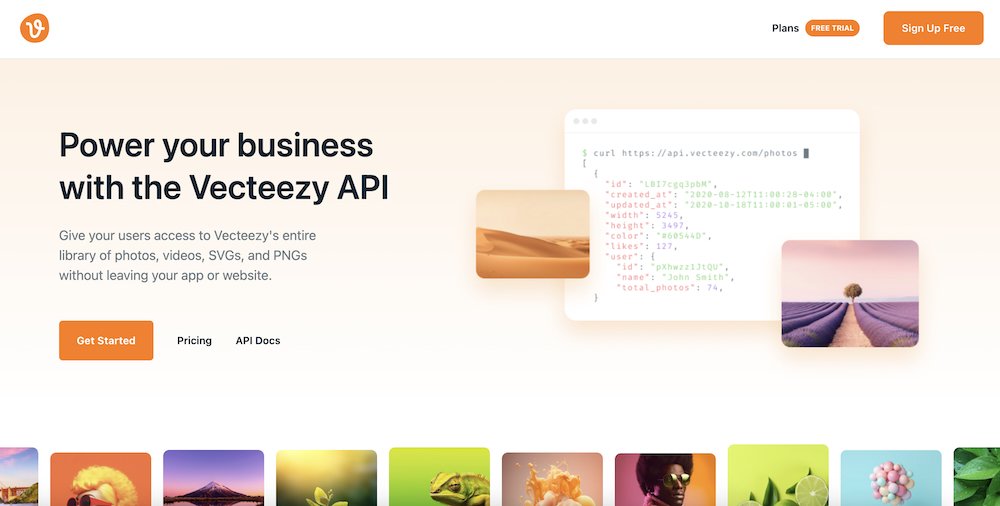
Vecteezy’s image API empowers businesses with seamless access to its extensive library of photos, videos, SVGs, and PNGs directly within your app or website. Its REST API is renowned for its simplicity and ease of integration, making it suitable for both first-time coders and tech giants alike. With its powerful AI search algorithm, users can perform keyword searches, apply filters, and easily download resources, providing effortless access to Vecteezy’s entire library of assets.
Vecteezy’s worry-free licensing options allow users on paid plans to utilize resources for commercial use without the need for attribution or royalties. Additionally, they offer free trial options and custom enterprise plans tailored to your specific needs.
Trusted by top brands like Microsoft, Disney, Facebook, and the BBC, Vecteezy offers flexible plans to ensure access to professional assets at affordable rates. Users can also monetize their work through Vecteezy’s Contributor Program or Affiliate Partner Program, earning money by sharing their content or promoting Vecteezy to drive traffic and sales.
Standout features
- Extensive content library
- Powerful search capabilities
- Flexible licensing
2. Cloudinary
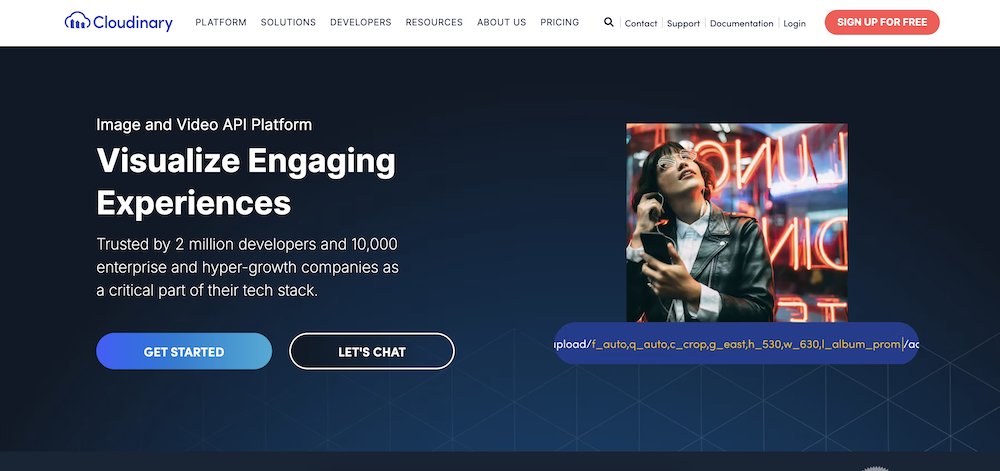
Cloudinary stands as a comprehensive cloud-based image and video management platform, trusted by over 2 million developers and 10,000 enterprise companies worldwide. The platform’s robust API ecosystem empowers businesses to store, transform, optimize, and deliver media with unprecedented efficiency and scalability.
Cloudinary’s strength lies in its dual focus on both image and video processing, offering powerful APIs alongside intuitive widgets and a user-friendly interface. The cloud-native architecture supports seamless integration through built-in integrations, extensible APIs, and webhooks, making it ideal for businesses building composable tech stacks.
The platform excels particularly in e-commerce, where it scales to support millions of product images and videos for high-performing shopping experiences. Beyond static images, Cloudinary’s complete video API delivers real-time video transcoding, content-aware compression, and on-the-fly video transformation capabilities.
Standout features
- Complete image and video API ecosystem
- Real-time transformation and optimization
- Enterprise-grade scalability and performance
3. iStock
Harnessing the resources of the Getty Images brand, iStock offers an API known for delivering exceptional images, videos, and illustrations directly to your platform, enhancing user experiences and driving engagement.
When you download files from iStock, you acquire a versatile license enabling unlimited usage across various mediums. Additionally, extended licenses are available for expanded usage rights, allowing you to maximize the potential of their content in various ways.
iStock provides two options for affiliates: the Affiliate JavaScript Widget and the Affiliate Search Endpoint. The Affiliate JavaScript Widget enables partners seeking quick integration to swiftly incorporate iStock photos, illustrations, and vectors onto their sites. In comparison, the Affiliate Search Endpoint offers greater flexibility, allowing affiliates to customize search result layouts, image sizes, text, and more. Separate endpoints for images and videos are available, ensuring optimized speed and ease of use for affiliates.
Standout features
- Access to both Getty Images and iStock libraries
- Revenue earning opportunities
- Customizable integration
4. Dreamstime
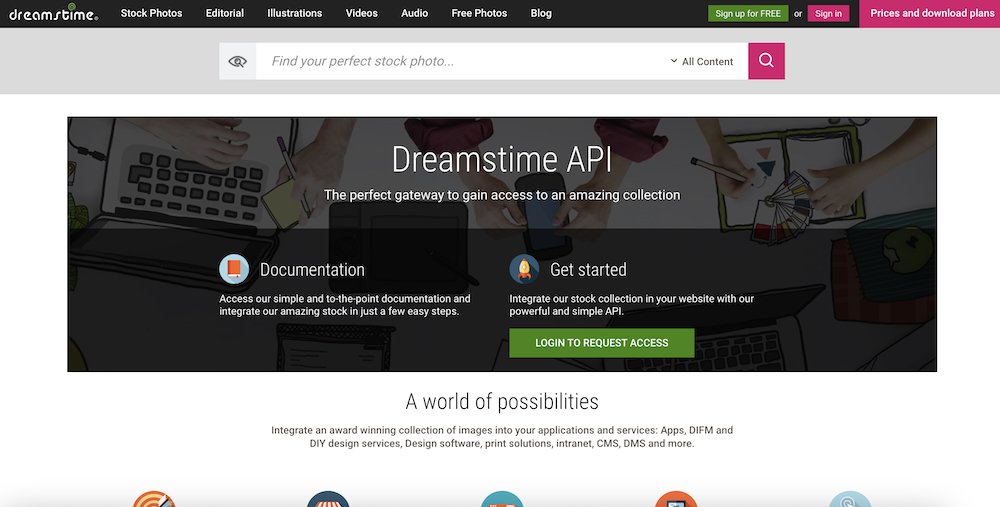
Dedicated to delivering high-quality digital imagery, Dreamstime’s image API provides a comprehensive range of pricing options to suit various needs. There are three distinct functionalities to cater to different user requirements: Partner/Search, Business, and Enterprise/Intranet. These functionalities facilitate effortless integration of Dreamstime’s acclaimed image collection into various applications and services, allowing users to effortlessly access Dreamstime’s extensive image library.
The Partner/Search functionality allows users to explore royalty-free stock within a branded environment, earning recurring revenue through the affiliate program. The Business functionality enables easy integration, allowing customers to select images for products and earn extra revenue. The Enterprise/Intranet functionality provides effortless integration with CMS and DAM solutions.
Additionally, Dreamstime offers a Reseller option and an Affiliate Program, both of which offer recurring revenue opportunities, with real-time reporting and promotional materials. These features provide a user-friendly solution for incorporating high-quality visual content into various projects and platforms.
Standout feature
- Access an award-winning collection of images
- Comprehensive range of pricing options
- Easy integration into a variety of platforms including CMS, DAM, and Social Media
5. Openverse
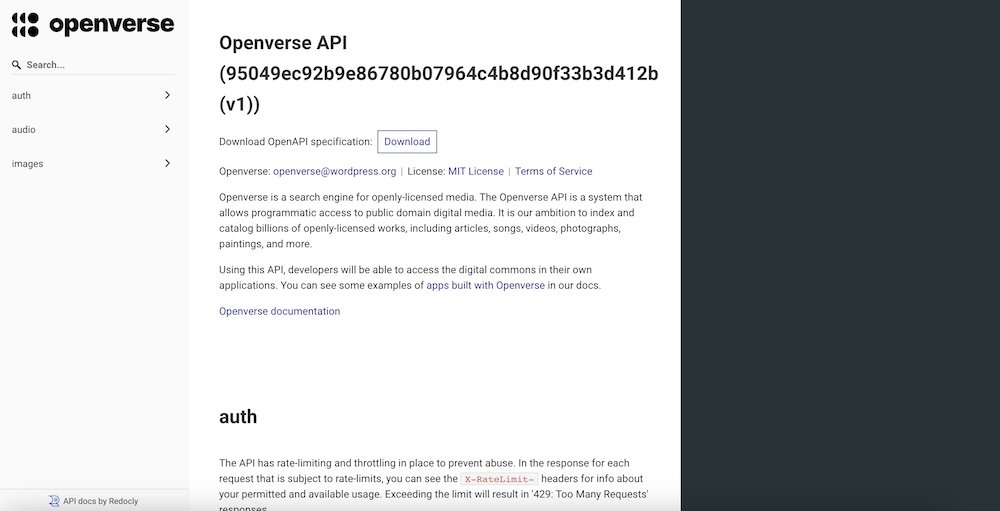
Openverse’s Image API provides developers and content creators with seamless access to openly licensed images sourced from various archives and collections. With this API, users can effortlessly integrate a diverse range of images into their applications, spanning various genres and subjects.
Equipped with advanced search capabilities, developers can refine their image queries based on specific criteria such as license type, creator, and tags. Additionally, the API offers convenient features like machine-generated tags and one-click attribution, streamlining content reuse while ensuring proper acknowledgment of creators. Furthermore, Openverse prioritizes transparency and community involvement, fostering collaboration and promoting accessibility within the digital content ecosystem.
Standout feature
- Open-source
- Machine-generated tags and one-click attribution
- Emphasis on transparency and community involvement
6. MediaWiki
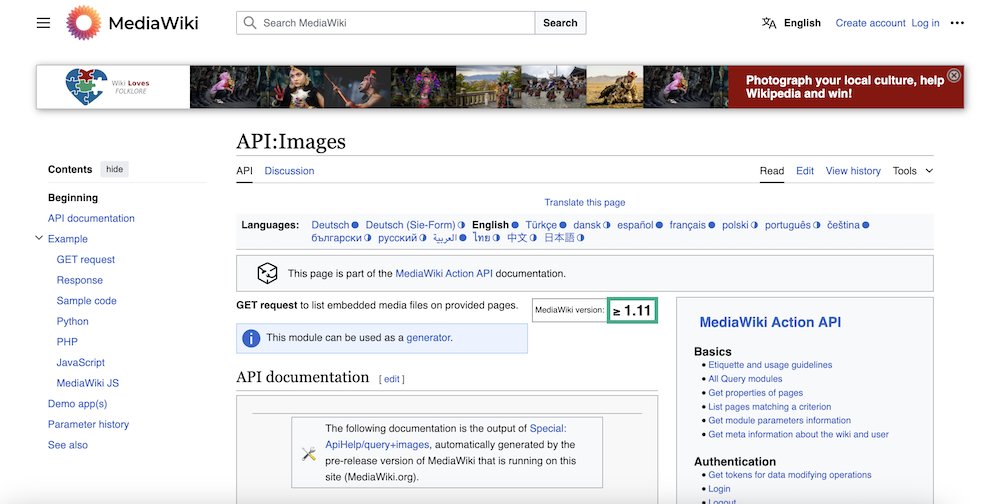
Another open-source and community-oriented image API is MediaWiki. A member of the Wikipedia family, MediaWiki’s API serves as a fundamental resource for wiki developers and content creators, offering seamless integration and robust functionalities tailored to meet diverse needs. It empowers users within the MediaWiki ecosystem to interact with images effortlessly, providing comprehensive functionalities for image retrieval, management, and utilization.
Specific modules, such as API Images and API Image Usage, enable users to retrieve detailed file information and efficiently track the usage of specific images across the wiki. Although direct image downloading is not supported, the API provides access to image URLs, ensuring versatility in image-related tasks and facilitating integration.
Notably, all features of MediaWiki, including its Image API, are freely available under the terms of the GNU General Public License (GPL), providing a cost-effective solution for efficient image management.
- Community-oriented and open-source
- Module-based functionality
- Perfect for Wiki Creators
7. Flickr
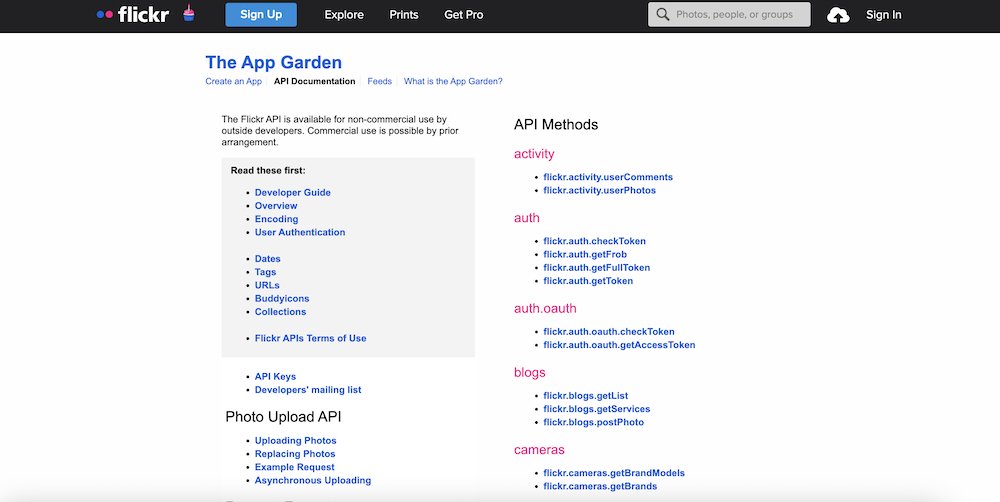
Flickr’s API, an integral component of the renowned photo-sharing platform, provides developers with an open-API tailored to seamlessly interact with Flickr’s extensive array of resources. The API grants developers access to a diverse range of content, spanning photos, videos, tags, profiles, and groups.
The Flickr Image API boasts several noteworthy features, including flexible data access that allows developers to creatively remix content. Additionally, it offers robust search capabilities with various filters, offering insights into trends in image popularity. Furthermore, developers can enhance their content with metadata through comments and access geo-location data indicating where photos were captured.
Recognized for its reliability and robustness, Flickr’s API is relied upon by developers worldwide for its scalability, accommodating projects of all scopes. This scalability ensures adaptability and flexibility for both burgeoning endeavors and expansive applications, empowering developers to nurture their projects organically within Flickr’s ecosystem.
Standout Features
- Leverage Flickr’s extensive content
- Open-source SDK
- Scalable for all projects
8. 123RF
The 123RF Stock Content and Image Enhancement API Program offers a robust set of features and benefits tailored for developers, website owners, and creative professionals. Users can seamlessly integrate 123RF’s vast collection of stock photos, vector illustrations, and video footage into their websites, applications, or platforms with ease. The API program also provides white-label options, allowing unlimited access to 123RF’s extensive library.
Additionally, developers can enhance user experiences by customizing options across 123RF’s Free, Plus, and Premium collections. Workflow optimization is another highlight, with AI-powered tools simplifying creative processes and delivering optimized results, such as an AI image generator.
Furthermore, users benefit from the ability to integrate millions of images with powerful search filters and flexible licensing models tailored to their business needs. Clear and comprehensive technical documentation facilitates easy integration and maintenance, while dedicated support from an API Success Manager ensures a smooth setup process and ongoing assistance for teams.
Standout features
- Original image generation
- Powerful search filters
- Impressive range of AI-powered tool
9. Shutterstock
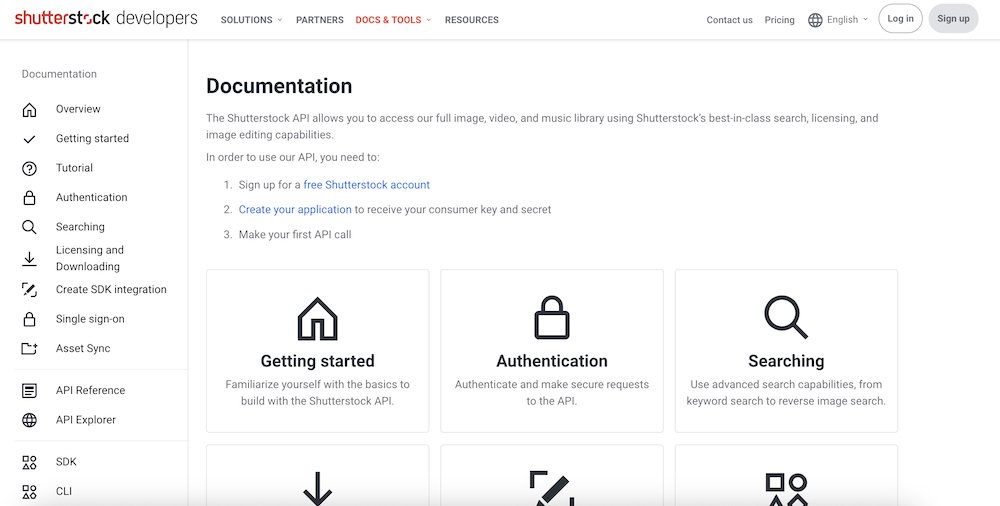
Shutterstock’s image API provides developers with easy access to a vast collection of media resources. With a simple sign-up process, users can quickly tap into this resource pool. Key features include advanced search capabilities, comprehensive licensing options, and editor integration for effortless image customization.
The Shutterstock API offers an SDK, particularly a JavaScript library, along with examples in various programming languages available in the API reference. This streamlines the integration process and ensures accessibility for developers of all levels. The API also provides detailed analytics, high-resolution previews, multi-language support, and robust encryption for secure transactions.
Another highlight is Shutterstock’s comprehensive subscription coverage, which accommodates all Shutterstock subscriptions, thus ensuring a holistic solution for all media needs, regardless of project scope or scale.
Standout features
- Comprehensive Developer Support (including JavaScript library)
- Detailed Analytics
- Comprehensive Licensing Options
10. Adobe Stock API
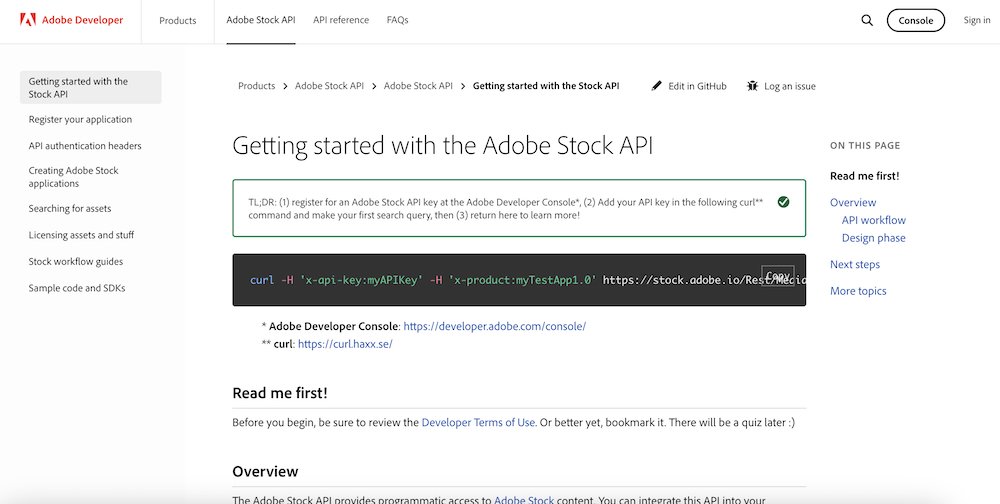
The Adobe Stock API offers a robust collection of Adobe Stock content, spanning diverse assets such as photos, videos, and vector files. Its user-friendly and straightforward integration process seamlessly integrates into your organization’s applications and workflows. With simple HTTP requests, users can efficiently search for, retrieve, and license specific assets.
One of the most notable features of the Adobe Stock API is its flexibility. Users can customize search parameters, access licensing histories for streamlined asset management, and retrieve detailed metadata for each asset. This versatility caters to both internal users and external customers, enhancing its appeal as a multifaceted tool.
Compared to other image APIs, Adobe Stock excels with its extensive content library, intuitive integration process, and comprehensive asset management controls. It offers a robust, adaptable, and user-centric solution for accessing top-tier visual content.
Standout features
- Extensive content library
- User-friendly integration
- Detailed asset management
Bonus: API for e-commerce by Depositphotos
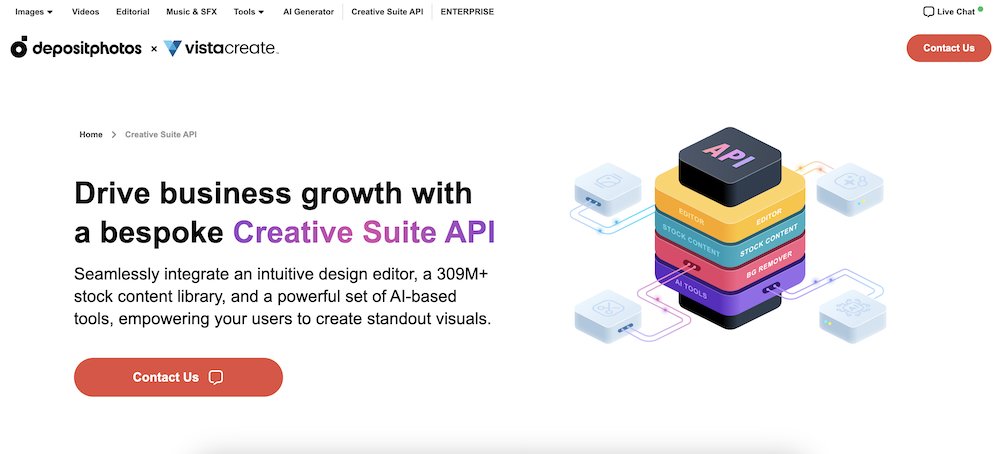
API for e-commerce by Depositphotos is designed for companies looking to simplify their content creation process. It offers quick and easy integration of relevant features into existing platforms without having to pay for the full suite of tools.
This customizable Creative Suite API enables businesses to seamlessly incorporate an intuitive design editor, access to a massive stock library, and powerful AI-based tools. The VistaCreate design editor component provides over 200K templates in 80+ formats for both print and digital media, while the stock content library contains more than 309 million photos, vectors, illustrations, videos, and music files.
What truly distinguishes Depositphotos is its white-label option, allowing businesses to completely rebrand features to mirror their identity and enhance their competitive edge. With its secure and compliant technology, the API ensures businesses can scale confidently while maintaining brand consistency, making it an ideal solution for e-commerce platforms seeking to enhance their creative capabilities.
Standout features
- White-label customization options
- 309M+ stock content library
- VistaCreate editor with 200K+ templates
- Pay-for-what-you-need flexibility
Frequently asked questions
What are the different types of image APIs?
- Stock Photo APIs provide access to libraries of photos, videos, and other media.
- Search APIs enable users to conduct searches, access media information, and previews, as well as license and download media content.
- Social Media APIs provide access to user-generated content on social media platforms.
- Content Management APIs provide functionalities to manage and manipulate digital content.
- Monetization APIs provide ways to earn revenue through various means such as affiliate marketing or content licensing.
How much do image APIs cost?
The cost of using image APIs can range from free for basic usage to potentially significant expenses for high-volume or enterprise-level usage with premium features and support. It’s essential to carefully review the pricing details, including any usage limits, tiered pricing structures, and additional fees, to understand the total cost and determine the best fit for your needs and budget.
Can I freely use images obtained through APIs on my website?
It depends on the terms of service, licensing agreements, and usage rights associated with the images provided by the API. Some images may be available under Creative Commons licenses, allowing for certain types of usage with proper attribution, while others may require purchasing licenses for commercial use.
Are there any restrictions on the number of images I can use from an API?
API providers may impose limitations on the number of images you can access or download within a certain timeframe, especially if the API has usage tiers or rate limits. Check the API documentation or terms of service for any restrictions or usage limits.
The bottom line
The availability of diverse image APIs offers a straightforward path to improving user experiences and engagement online. Whether you’re a developer building websites, a content creator looking for relevant visuals, or a digital agency streamlining workflows for clients, leveraging image APIs can significantly enhance creativity and deliver impactful content across platforms.