
Looking to understand where remote work stands in 2025? You’re in the right place! The landscape has shifted dramatically since the pandemic, and the latest data reveals some fascinating trends that might surprise you.
I’ve dug through the most recent primary research and official government data to bring you the real numbers behind remote work in 2025. Whether you’re a job seeker weighing your options or an employer crafting policies, these statistics paint a clear picture of where we are and where we’re headed.
Bottom line up front: Remote work has stabilized as a permanent fixture of the modern workplace, with three-quarters of workers enjoying location flexibility while companies adapt their strategies to attract and retain top talent.
Remote job statistics for 2025
1. 75% of workers now have location flexibility
Here’s the headline statistic that defines 2025: 75% of employed adults who have jobs that can be done from home are working remotely at least some of the time, according to Pew Research Center’s January 2025 survey. This represents a massive transformation from pre-pandemic levels when remote work was essentially a niche perk.
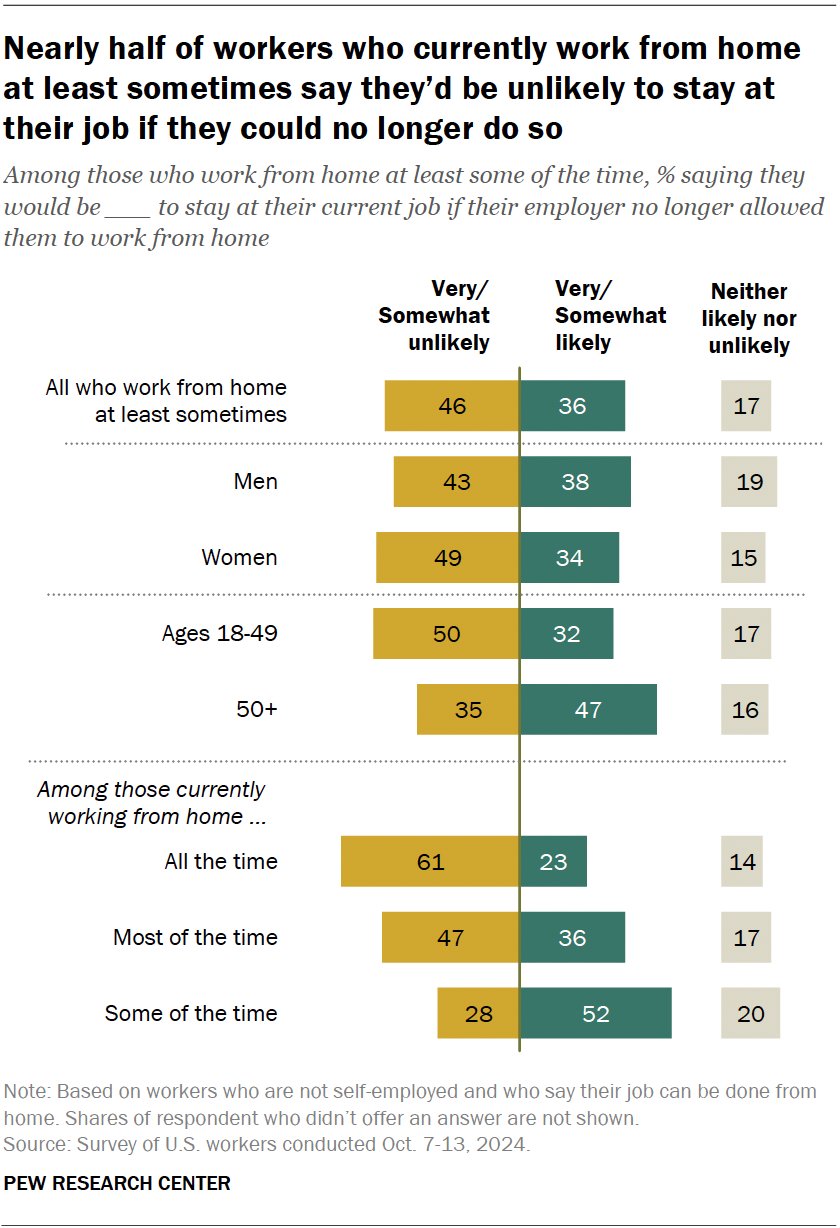
What makes this even more significant is employee commitment to these arrangements. The same Pew study found that 46% of workers say they’d be unlikely to stay at their current job if their employer no longer allowed remote work, including 26% who say they’d be very unlikely to stay.
The data reveals that remote work isn’t just a temporary pandemic response—it’s become the new normal. Most professionals now expect some level of location flexibility, and companies that don’t offer it risk falling behind in the talent race.
2. 48% of job seekers want hybrid work, only 26% want fully remote
The preference data tells a clear story: Nearly 48% of job seekers surveyed said they would like to find a hybrid role, while over a quarter (26%) said they would prefer a fully remote job, according to Robert Half’s 2025 Demand for Skilled Talent report. This insight comes from their comprehensive analysis of hiring trends across multiple industries.
The preference for hybrid work reflects something important: most professionals want flexibility without completely abandoning in-person collaboration. They’ve experienced the benefits of remote work during the pandemic but also recognize the value of face-to-face interaction for certain activities.
Robert Half’s research found that 29% of professionals are already looking or planning to look for a new role in the first half of 2025, with the desire for more work flexibility being a top motivator for their job hunting. This puts pressure on employers to offer flexible arrangements or risk losing talent to competitors who do.
3. Remote jobs jumped from 4% to 15% of all opportunities since pandemic
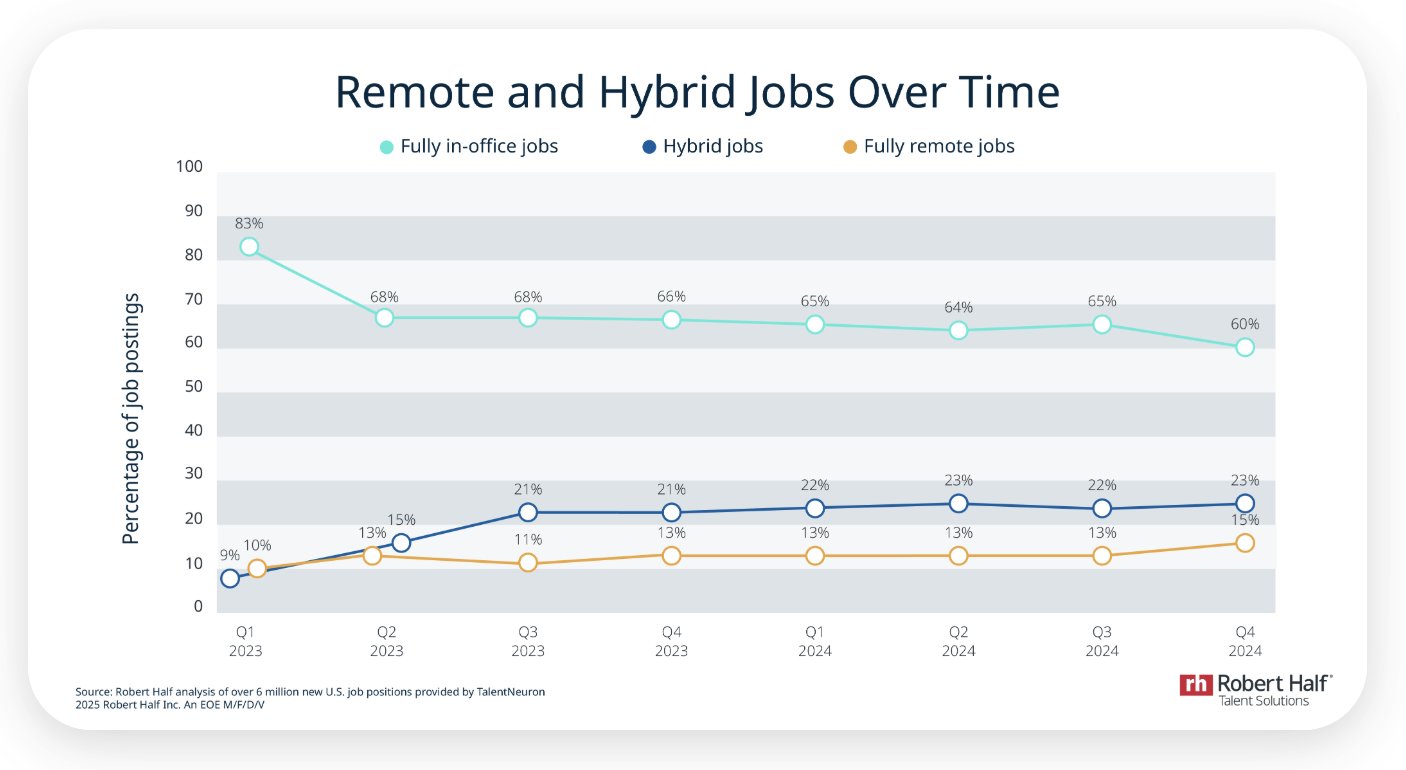
The transformation is dramatic when you look at the numbers: Remote jobs now make up 15% of all new U.S. job postings in Q4 2024, up from around 4% before the pandemic, according to Robert Half’s analysis of over 6 million job positions. Additionally, hybrid roles now account for 23% of new job postings.
This nearly four-fold increase shows that remote work opportunities have become a significant portion of the job market, particularly in high-paying roles. The growth isn’t slowing down either—Robert Half’s data shows this trend has stabilized rather than declined.
What’s particularly interesting is how this varies by industry. Technology employers had the most job postings for fully remote jobs (18%), while legal employers had the least (8%). The data shows that remote work opportunities remain concentrated in knowledge work sectors where physical presence isn’t required for core job functions.
4. Remote work boosts productivity by 13% in controlled studies
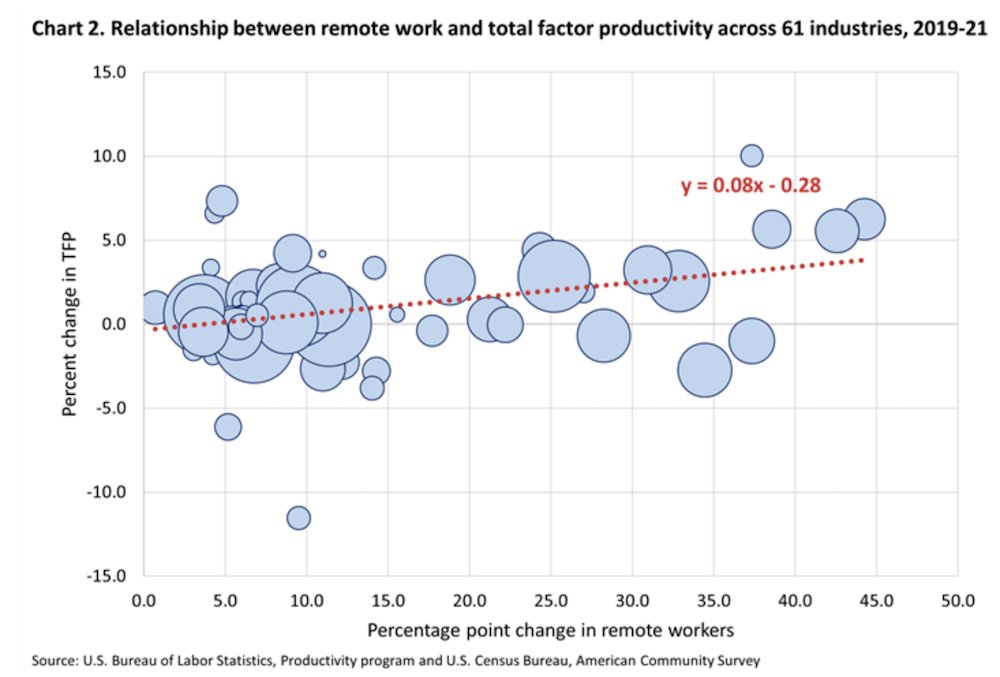
One of the biggest concerns about remote work was productivity, but government data definitively settles this debate: The U.S. Bureau of Labor Statistics found that industries that saw larger increases in remote work during the pandemic also experienced faster productivity growth. Specifically, for every 1 percentage-point increase in remote work, there was about a 0.08 to 0.09 point rise in total factor productivity.
This isn’t just correlation either. Stanford economist Nicholas Bloom’s controlled studies have consistently shown productivity improvements. In one landmark study, Bloom found a 13% improvement in performance from people working at home, along with significantly reduced turnover rates.
The productivity gains come from multiple factors: eliminated commute time, fewer office distractions, and the ability to work during personally optimal hours. The Bureau of Labor Statistics research shows that among the 10 industries with the largest increases in remote work, most had substantial increases in output, with output rising much faster than labor input.
5. Hybrid work cuts employee turnover by 33%
Stanford’s most recent controlled study provides compelling evidence for hybrid work benefits: In a randomized trial of 1,612 employees at Trip.com, quit rates were 33% lower in the hybrid group compared to the full-time office group. The study, led by Nicholas Bloom, had employees work either five days per week in the office or three days per week with remote work on Wednesdays and Fridays.
The impact on retention varied by group, with the greatest improvements among non-managers, women, and employees with long commutes. Satisfaction survey results were also more positive within the hybrid group. Importantly, the study found that hybrid work had no negative impact on performance reviews, promotion rates, or objective productivity measures.
This controlled research provides the strongest evidence yet that hybrid arrangements can significantly improve employee retention without harming performance, offering companies a clear competitive advantage in tight labor markets.
6. Top 10 remote-work industries saw massive output growth
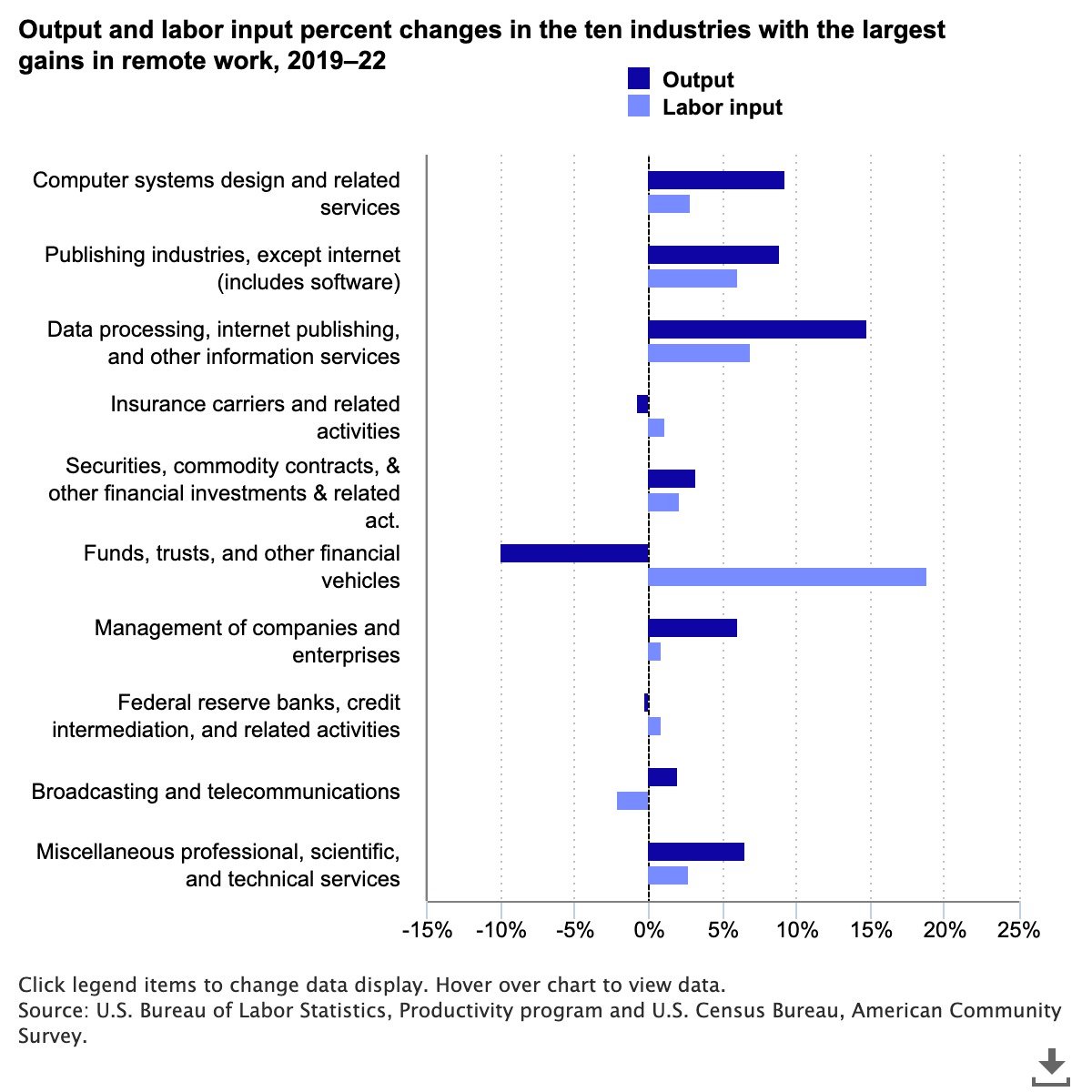
Government data reveals a striking pattern: Among the top 10 industries with the largest increases in remote work (20+ percentage points), most experienced substantial increases in output between 2019-2022, according to the Bureau of Labor Statistics.
The three industries with the largest remote work increases—computer systems design, publishing industries, and data processing/internet services—had large increases in both output and labor input, with output rising much faster than labor input. This suggests that remote work enabled these industries to increase productivity significantly.
The BLS data shows that remote work didn’t just maintain productivity—it actively contributed to economic growth in the sectors that embraced it most fully. This provides strong evidence that remote work arrangements can be economically beneficial at the macro level, not just for individual companies.
7. 81% of workers consider remote work most important job factor
FlexJobs’ 2025 research reveals a stunning priority shift: 81% of respondents said remote work is the factor they consider most important in a job, followed by salary (77%) and having a flexible schedule (72%), according to their State of the Workforce Report. The vast majority of workers agree that a fully remote (65%) or hybrid (34%) job is their ideal work arrangement moving forward.
This represents a fundamental shift in worker priorities, with location flexibility now outranking traditional concerns like compensation and benefits. The data shows that 58% would even accept a pay cut for the option to work remotely from anywhere.
FlexJobs also found that 87% of candidates are more willing to apply to a role if it offers remote work, and unclear remote work arrangements (60%) is one of the top reasons why workers say they would pull out of an interview process. The message is clear: companies that don’t offer flexibility are losing talent before interviews even begin.
8. Remote workers show 31% engagement vs 19% for office workers
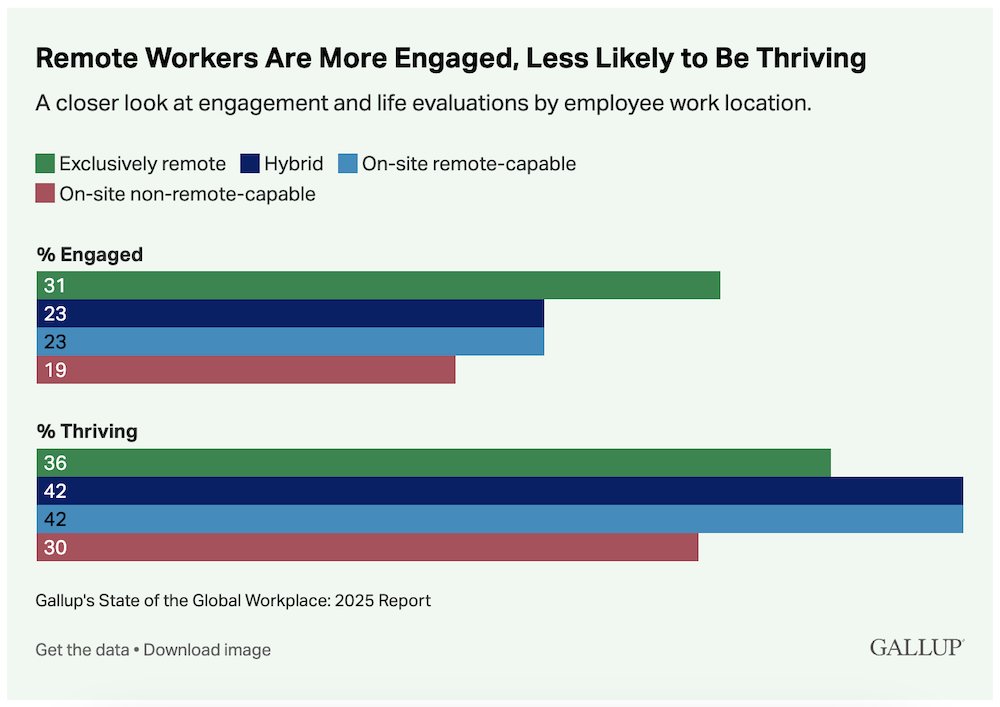
Gallup’s 2025 State of the Global Workplace reveals a striking engagement paradox: Globally, fully remote workers are most likely to be engaged at work (31%), compared with hybrid (23%), on-site remote-capable (23%) and on-site non-remote-capable (19%). This higher engagement may stem from the autonomy remote work provides, allowing employees to play to their strengths and reach flow states more easily.
However, the same research uncovers a concerning trade-off: although fully remote workers report higher engagement, they are less likely to be thriving in their lives overall (36%) than hybrid workers (42%) and on-site remote-capable workers (42%).
The research suggests that for some employees, remote work may feel like “just work,” without the friendships, team lunches, and camaraderie that on-site work can provide. This isolation can contribute to loneliness and, in the absence of social support, affect overall well-being despite higher work engagement.
9. 57% would quit rather than lose remote work options
FlexJobs’ research reveals the strength of employee commitment to remote work: 57% said they would “absolutely” look for a new job if they were not allowed to continue working remotely in their current position, according to FlexJobs’ Workforce Report. The data also shows that 35% of people said they know someone who has quit or is planning to quit because their employer is requiring them to return to the office.
This stark finding highlights the retention risk companies face when implementing return-to-office mandates. FlexJobs found that 67% of workers said they plan to change jobs in the next six months, but 34% said the ability to work remotely would prevent them from leaving.
The research also reveals that nearly 1 in 4 workers (23%) faced return-to-office mandates in the past year, creating significant workforce tension. For companies trying to balance office presence with employee satisfaction, these numbers suggest that flexibility isn’t just a perk—it’s a critical retention tool.
10. Executives predict remote work will keep growing despite RTO mandates
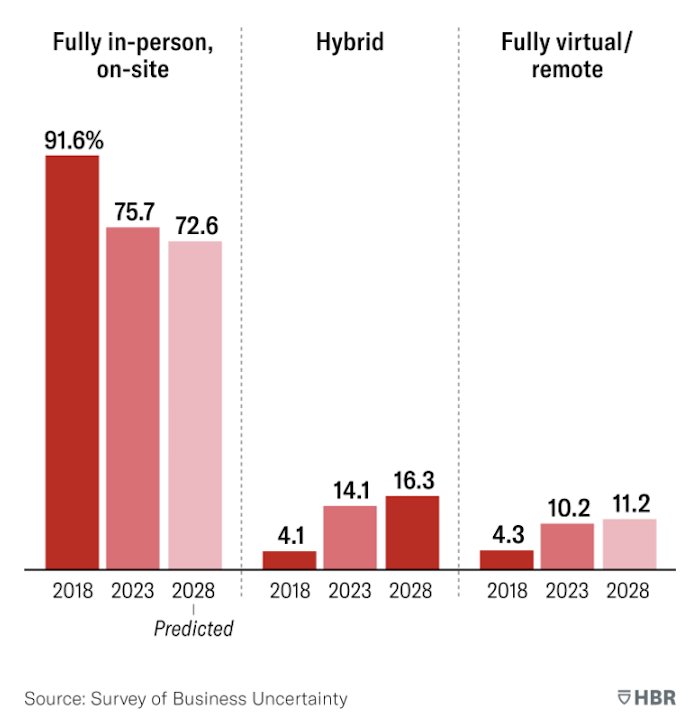
A Harvard Business Review analysis of executive surveys reveals a telling contradiction: While many CEOs publicly push return-to-office mandates, executives privately expect both fully remote and hybrid work to continue growing. The Survey of Business Uncertainty, conducted jointly by the Atlanta Federal Reserve Bank, University of Chicago, and Stanford, found that senior executives expect remote work to increase over the next five years.
When asked about their firms’ workforce in 2028, executives predicted significant growth in both remote and hybrid arrangements. This disconnect between public RTO policies and private predictions suggests that market forces will ultimately favor flexibility over mandates.
The research notes that remote work is valued by employees about the same as an 8% pay increase, creating powerful economic incentives for companies to offer flexibility. As remote-working technology continues to improve and employees gravitate toward firms with flexible policies, the data suggests that executive predictions—not their current mandates—will prove accurate.
What these statistics mean for 2025 and beyond
The primary source data paints a clear picture: remote work has evolved from a pandemic necessity to a permanent feature of the modern workplace. The government statistics show that both employees and employers have adapted successfully, with productivity remaining high and economic benefits clearly demonstrated.
For job seekers
These numbers suggest that remote or hybrid opportunities will continue to be abundant, particularly in knowledge work sectors. The research shows you shouldn’t have to sacrifice career advancement for location flexibility.
For employers
The retention and productivity statistics are particularly telling. Stanford’s controlled studies and the Bureau of Labor Statistics data suggest that flexible work arrangements don’t hurt business performance—they may actually improve it.
Looking ahead
Stanford’s Nicholas Bloom predicts that the percentage of hours worked from home will continue to increase due to practical factors like expiring leases (companies downsizing to save on real estate) and younger executives being more favorable to remote work.
The future of work isn’t fully remote or fully in-office—it’s flexible, with companies and workers finding arrangements that balance productivity, collaboration, and quality of life. The data from government agencies, academic research, and major employers suggests this transformation is permanent, reshaping how we think about careers, talent acquisition, and workplace culture for years to come.
Ready to find your ideal remote role? The statistics show you’re not alone in prioritizing flexibility in your career. If you’re looking for a place to find a remote job, I recommend checking out these job sites for remote work.