
Ready to sell your Amazon FBA business? With the ecommerce industry booming and strong demand for FBA businesses, 2025 could be your perfect time to exit.
But choosing where to sell is crucial. The right platform can mean the difference between a quick, profitable sale and months of frustration. Beyond getting the highest valuation, you must consider fee structures, support levels, migration assistance, and more.
Let’s explore the best places to sell your Amazon FBA business in 2025, along with essential details about the selling process to help you make an informed decision.
1. Empire Flippers
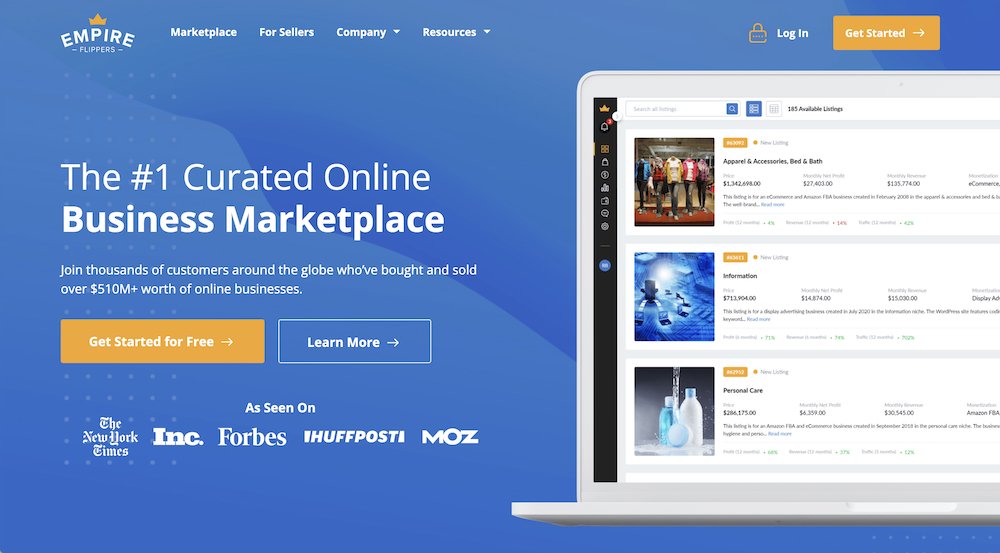
Best for: Profitable FBA businesses between $100k to $10m+
Total sold: 2,400+ businesses and $520m+ in sales
Success fee/commission: 15% under $700k, 8% $700k-$5m, 2.5% over $5m
Buyer pool size: 100k+ vetted buyers with $12.5+ billion in verified liquidity
Service model: Full-service seller support from valuation to migration
A powerhouse in the FBA space, Empire Flippers combines extensive marketplace expertise with white-glove service. Their thorough vetting process and dedicated migration team ensure smooth transactions, while their vast network of qualified buyers actively seeking FBA acquisitions helps secure optimal valuations. Ideal for serious sellers seeking comprehensive support throughout their exit journey, especially those in the $100k-$10m range.
2. exit.io
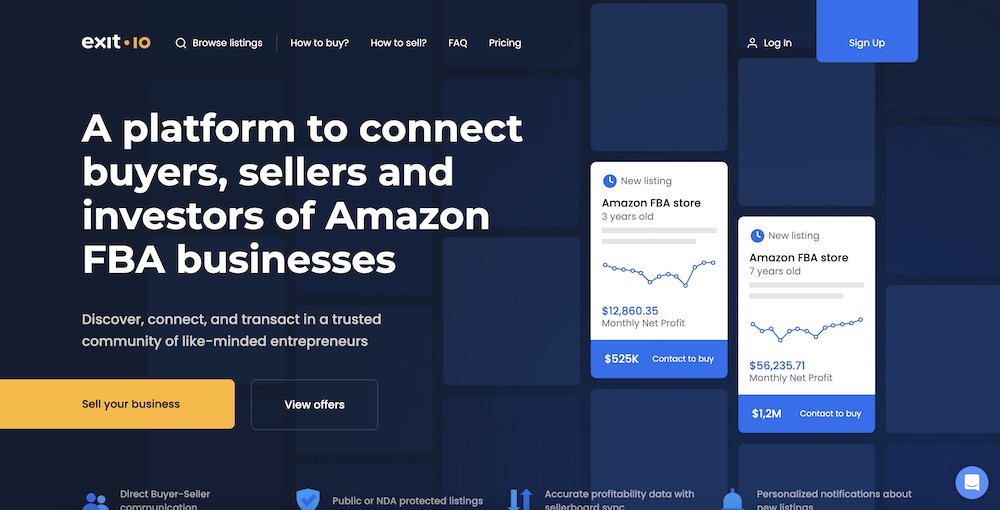
Best for: Amazon FBA businesses from $50 to $6.5m+
Total sold: Growing marketplace with active FBA community
Success fee/commission: Zero commission fees for sellers
Buyer pool size: Community of verified Amazon FBA entrepreneurs
Service model: Peer-to-peer marketplace with optional sellerboard integration
A commission-free marketplace, completely free for all buyers and sellers, built exclusively for Amazon FBA entrepreneurs, Exit.io eliminates seller fees entirely while connecting you directly with other FBA sellers and investors. Their sellerboard integration provides verified financial data through trust badges, increasing buyer confidence without additional costs. The peer-to-peer approach fosters better relationships and often smoother negotiations since both parties understand the FBA business model intimately.
3. Flippa
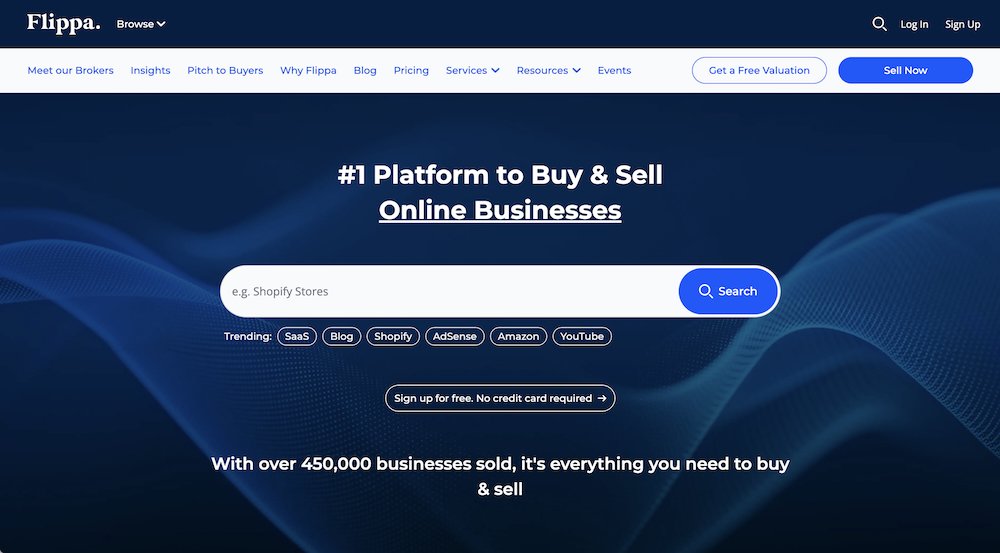
Best for: Smaller FBA stores between $10k-$100k+
Total sold: 450k+ businesses and digital assets sold
Success fee/commission: 10% under $10k, scales down to 3% over $50m, plus various fixed listing fees depending on requirements
Buyer pool size: 40k+ weekly active buyers and 17k new monthly buyers
Service model: Self-service marketplace with optional broker support
A high-volume marketplace designed for smaller FBA operations, Flippa offers swift market access through its auction-style platform. Flippa is the world’s largest marketplace for online businesses, so there are a lot of active buyers. While lacking hands-on support by default, their competitive environment creates dynamic bidding opportunities. The platform works best for experienced sellers who can independently handle buyer screening and negotiations.
4. Website Closers
Best for: Established branded FBA businesses over $500k-$1m, and even up to $100m+
Total sold: 2,300+ businesses sold with over $2.2 billion in total sales volume
Success fee/commission: Undisclosed, but likely a percentage on sale with no listing fee
Buyer pool size: 800k+ vetted buyers with billions in liquidity
Service model: Comprehensive service with a dedicated team of M&A advisors
Specializing in complex, branded FBA operations, Website Closers excels at handling sophisticated transactions involving multiple suppliers and international considerations. Website Closers can handle a sale as low as $500k or as high as $100m+. Their comprehensive M&A approach suits established brands seeking strategic buyers, with dedicated advisors managing everything from valuation to closing.
5. TheFBABroker
Best for: FBA businesses selling for $1m+
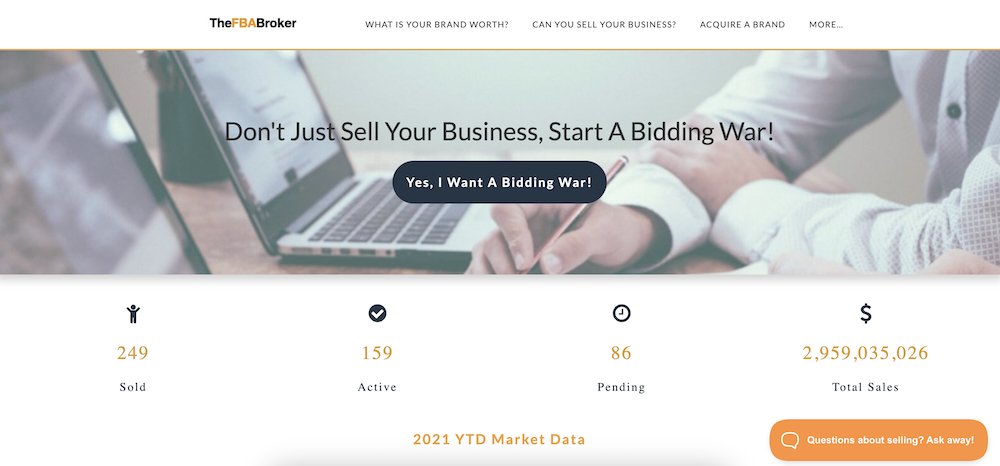
Total sold: 250 FBA businesses sold and $2.9+ billion in total sales
Success fee/commission: Not disclosed, but likely a percentage of the final sale price
Buyer pool size: Outreach to strategic buyers looking for FBA acquisitions
Service model: Dedicated marketing and M&A team through the sales process
As an Amazon FBA business specialist broker, TheFBABroker brings deep platform-specific knowledge to every transaction. Their focused approach and understanding of Amazon-specific metrics help maximize valuations for complex FBA operations. They excel at positioning and selling multi-marketplace operations, with strategic buyer outreach and expertise in brand registry and account health considerations.
6. FE International

Best for: Larger, more complex FBA brands from $1-$5m to $20-$100m +
Total sold: 1,500 + total businesses sold with a combined value of $50+ billion
Success fee/commission: Not disclosed but likely no listing fee if accepted and a percentage of final sale depending on the price
Buyer pool size: Approved pool of 80k+ qualified and vetted tech investors/firms
Service model: In-house team of CPAs, CFAs, and dedicated M&A professionals
FE International specializes in complex FBA acquisitions through its comprehensive M&A advisory service. Their in-house team of financial professionals handles everything from valuation through closing, making them ideal for sophisticated sellers seeking expert guidance for larger exits. While their fee structure isn’t publicly disclosed, they provide full-service support and thorough due diligence for brands looking to maximize their sale value.
7. Quiet Light
Best for: Established FBA businesses between $500k to $20m+
Total sold: 750+ businesses sold with over $500m in sales
Success fee/commission: Undisclosed, but likely a tiered percentage commission on sale
Buyer pool size: Vetted pool of founders and firms with billions in liquidity
Service model: Dedicated assigned advisor to manage the entire sales process
Founded by entrepreneurs for entrepreneurs, Quiet Light leverages their advisors’ firsthand exit experience to guide sellers through complex FBA transactions. Their approach focuses on optimizing business fundamentals and positioning owner-operated businesses for premium valuations, with particular strength in inventory-heavy operations worth $500k to $20m+. They’ve completed small and large sales and are a great broker to consider.
Frequently Asked Questions
Are you allowed to sell Amazon FBA businesses?
Yes, if your FBA business operates as a legal entity (for example, an LLC or equivalent). You’re selling the business entity while the Amazon account stays with it. Direct account sales are prohibited.
What’s a typical FBA business worth?
Your FBA business will likely sell for 2-4x annual profit (or 24-48x monthly profit), with premium proprietary brands reaching 5x annual (60x monthly). Key value drivers include your business’s age, growth rate, brand strength, supplier relationships, and operational systems. For example, if you have a premium FBA brand making $200K monthly profit with consistent YoY growth, it might sell for a 45x multiple ($9m), while a distressed business averaging $200K monthly profit might sell at a 15x multiple ($3m).
What disqualifies an FBA business from being sold?
Major disqualifiers include recent account suspensions, unresolved IP claims, excessive product returns (>2%), and supplier agreements that you can’t transfer. If you’re dependent on a single supplier (>70% of your inventory) or have significant sales decline (>30% year-over-year), these can also prevent deals from closing. Policy violations or manipulated reviews will create additional barriers.
What documentation do I need to prepare?
You’ll need to prepare 24+ months of financial statements, inventory reports, supplier agreements, SOPs, and trademark registrations. Most brokers will provide you with detailed preparation checklists and templates. And some will also help take a lot of the workload off your shoulders.
Should I use a broker or sell directly?
Your choice depends mainly on your experience and time availability. While direct selling through platforms like Flippa can save on commissions, brokers offer valuable expertise in valuation, buyer screening, and deal structuring. For most first-time sellers, a broker’s guidance proves worthwhile – they often secure better valuations through vetted buyer networks and help navigate complex deal requirements.
How long does it take to sell an FBA business?
You can expect the average timeline to be 3-6 months from listing to closing. If your business is smaller (under $500k), you might sell within 1-2 months. For larger deals over $5M, expect 6-12 months due to complex due diligence. Your time from listing to sale depends on various factors, including market conditions, your specific broker, and more.
Do I need to transfer my Amazon account?
You have two options: full account transfer or creating a new buyer account. Account transfers require Amazon’s approval and detailed documentation. Many buyers prefer creating new accounts and migrating products to maintain clean account health. The choice typically depends on your brand registry status and historical account performance.
How are inventory and supplier relationships handled during transfer?
Your inventory is typically sold at landed cost separate from the business purchase price. Your supplier relationships require formal introductions and often new agreements. Most deals include a 1-2 month transition period where you’ll facilitate supplier communications. Make sure your critical supplier agreements are transferable and documented before listing.
What happens to my brand registry and trademarks?
Your brand registry transfer requires trademark reassignment and Amazon’s approval. The process typically takes 2-4 weeks post-sale. You’ll need to provide trademark transfer documentation and update brand registry ownership through Amazon’s brand registry portal. Some buyers may require escrow until your brand registry transfer is completed.
How to Sell an Amazon FBA Business
1. Documentation & preparation
Start by compiling 24 months of your financial statements, P&Ls, and inventory data. Beyond financials, document your supplier contracts, SOPs, brand assets, and trademarks. For smoother due diligence, maintain clean records of your compliance documents, customer service metrics, and operational systems. A well-organized data room speeds up your sale process and builds buyer confidence. Any good broker will help you gather everything together.
2. Valuation analysis
For accurate valuation, analyze your trailing 12 months’ net profit while considering your growth trajectory and market position. Factor in your brand strength, product differentiation, and any supplier exclusivity agreements. Research recent comparable sales in your niche to benchmark your valuation expectations. If you’re working with a broker, they’ll usually help value your business for free after seeing your financials.
3. Pre-sale optimization
Before listing, resolve any outstanding issues: streamline your inventory management, clear IP disputes, optimize your PPC campaigns, and improve product listings. Develop comprehensive transition documentation, including training materials and SOPs. Focus on metrics buyers scrutinize: maintain your return rates below 2%, stabilize your growth trends, and ensure strong customer service performance.
4. Platform Selection
Choose between self-listing on marketplaces like Flippa if your business is under $50k-100k, or engaging marketplace/broker hybrids like Empire Flippers for larger operations between $100k-$10m+. Prepare for 3-6 months of due diligence and buyer negotiations. Having clean financials and documented processes significantly speeds up your sale process and maximizes valuation.
5. Due diligence & closing
Prepare for extensive buyer scrutiny of your business. Have clean financials, supplier agreements, and brand registry documentation ready. Expect 45-60 days of due diligence for standard deals. Create detailed migration plans covering inventory transfer, supplier introductions, and operational handover. Consider escrow services for secure payment handling and phased transitions.
Choosing Where to Sell Your Amazon FBA Business
Select your platform based on your business size, desired support level, and timeline. If you have a larger operation, you’ll benefit from hybrid broker/marketplaces and full-service brokers like Empire Flippers and Quiet Light, while smaller businesses may find better value in self-serving marketplaces like Flippa and Acquire.com.
Consider each platform’s experience with businesses similar to yours and their buyer network’s focus. Request multiple valuations before committing, as approaches and valuations can vary significantly. If your business has complex international operations or multi-channel sales, prioritize platforms with specific expertise. If you have unique intellectual property or proprietary systems, look for platforms that can communicate and sell that value.
Most importantly, ensure your chosen platform has experience selling businesses similar to yours in size and complexity. The right match will maximize your chances of a successful exit at the best possible valuation.
Remember, if you have a healthy, growing business, breathe. You’re the one with the gem buyers want, so act like it. Don’t rush to choose a marketplace or broker, don’t accept the first offer, and take your time negotiating favorable terms.
But at the same time, don’t overinflate your worth. Your business is worth what it’s worth, not what you feel it’s worth, so stay grounded and be realistic.
To get a free, instant valuation for your FBA business and see what it could sell for, check out Empire Flippers’ free valuation tool.