

With artificial intelligence becoming increasingly sophisticated, the need for reliable AI detection tools has never been more critical. Whether you’re an educator checking student work, a content creator ensuring originality, or a business maintaining quality standards, these seven AI detectors represent the best options available in 2025.
1. AI Detector — Editor’s Choice
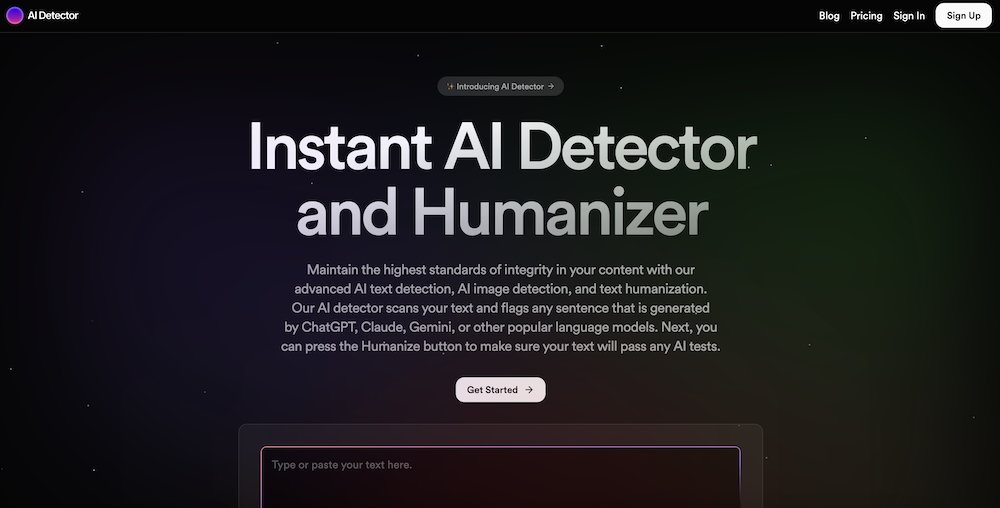
AI Detector offers a comprehensive solution that combines detection and humanization features. The platform provides instant AI detection with detailed authenticity reports and confidence scores, making it suitable for both academic and professional use.
Key Features
- Detects content from ChatGPT, GPT-5, Claude, Gemini, and other leading AI models
- Real-time analysis with detailed probability scores
- Text humanization feature to transform AI content into more natural writing
- AI image detection capabilities
- Per-sentence detection analysis
Pricing
Pay-as-you-go model starting at $40 for 400 credits (1 credit = 1,000 words detected), with monthly subscription options available starting from $19 per month.
The platform is particularly strong for users who need both detection and content refinement capabilities in one tool.
2. GPTZero
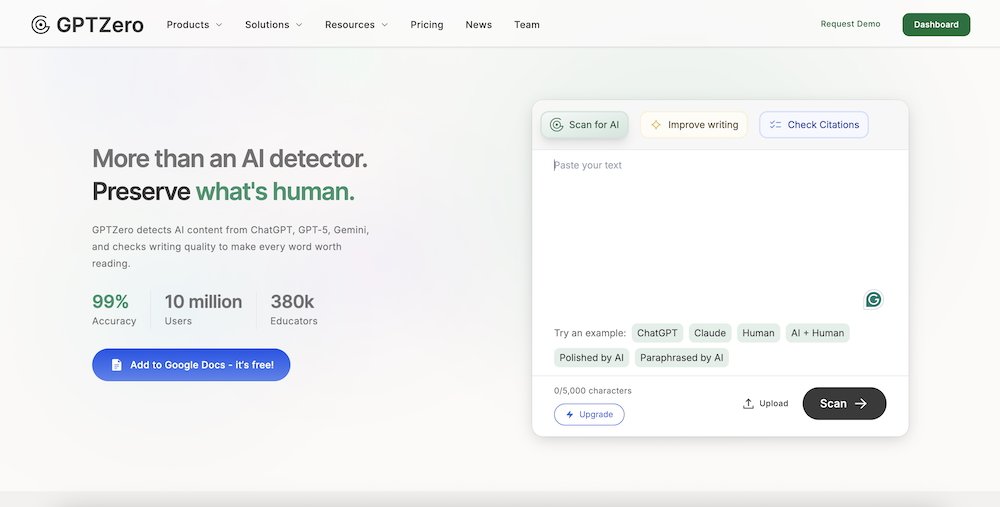
GPTZero has established itself as a leading AI detection platform with impressive accuracy rates and widespread adoption. With over 10 million users and 380,000 educators, it’s become a trusted solution in academic settings.
Key Features
- 99% accuracy rate according to internal testing
- Advanced scan capabilities for detailed analysis
- Integration with Google Docs, Canvas, Moodle, and Google Classroom
- AI vocabulary checking and writing feedback
- Plagiarism detection and citation checking
- Video replay feature for writing verification
Pricing
Free tier with 10,000 words per month, paid plans starting at $8.33/month (Essential) up to $24.99/month (Professional).
GPTZero excels in educational environments and offers robust integration options for classroom management systems.
3. Grammarly AI Detector
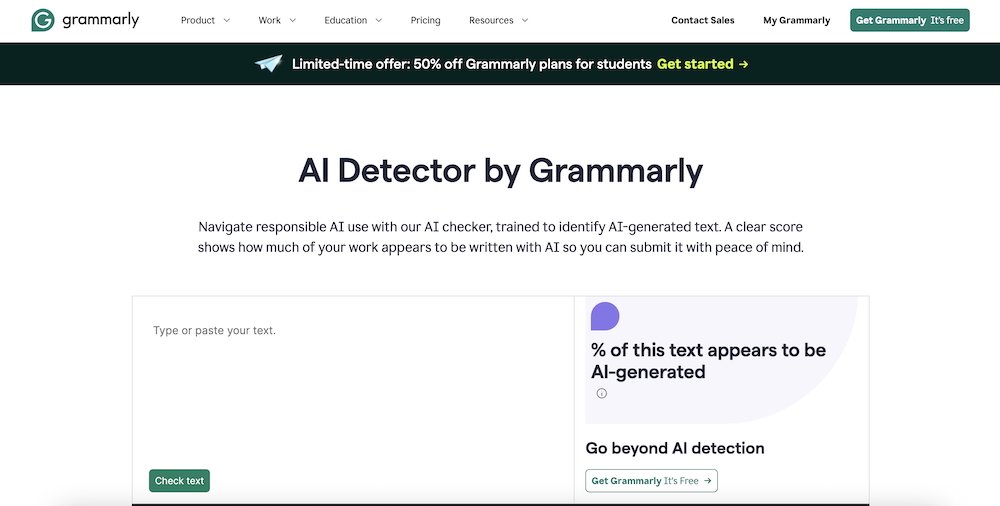
Grammarly’s AI detector leverages the company’s extensive experience in writing assistance to provide transparent AI detection. As a brand trusted by millions, Grammarly brings reliability and ease of use to AI content detection.
Key Features
- Detects AI content from Grammarly, ChatGPT, Google Gemini, and Claude
- Shows percentage of text that appears AI-generated
- Automatic AI usage citations in MLA, APA, or Chicago style
- Authorship categorization for mixed-source content
- Integration with 500,000+ apps and sites
Pricing
Free basic detection, with premium features available through Grammarly’s subscription plans.
This detector is ideal for users already in the Grammarly ecosystem who want seamless AI detection alongside their writing assistance tools.
4. Scribbr
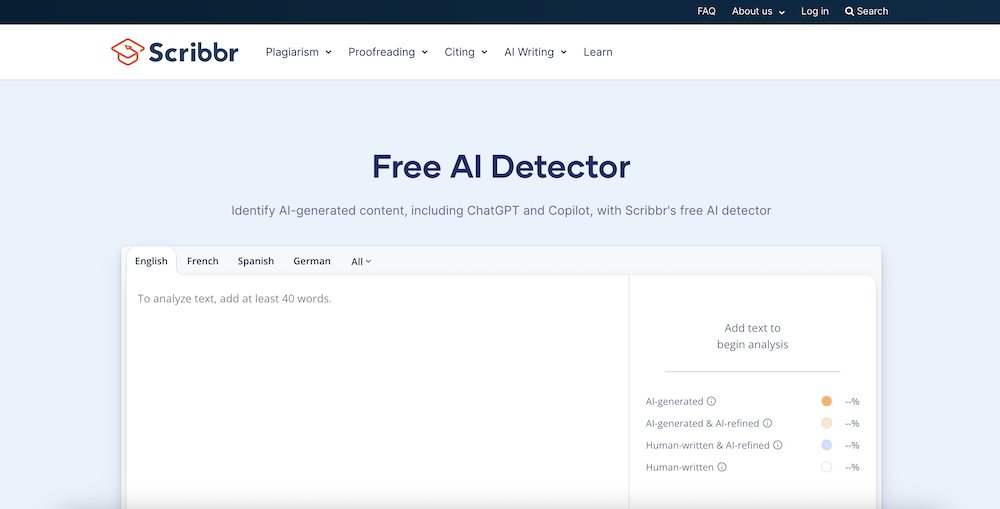
Scribbr’s AI Detector stands out for its multilingual support and unlimited free usage. The platform has built a strong reputation in academic circles and offers advanced features for detailed content analysis.
Key Features
- Unlimited free AI checks with up to 1,200 words per submission
- Supports multiple languages including German, French, and Spanish
- Paragraph-level feedback for detailed analysis
- Distinguishes between AI-generated, AI-refined, and human-written content
- No sign-up required for basic use
- Advanced algorithms for high accuracy detection
Pricing
Free unlimited use with word limits per submission.
Scribbr is particularly valuable for international users and those who need frequent, cost-free AI detection.
5. Undetectable AI
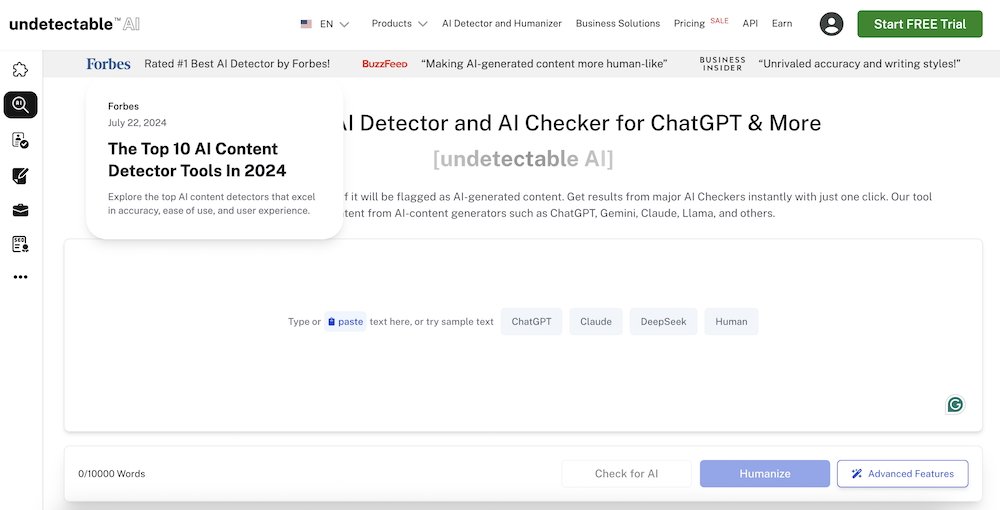
Rated as a top AI detector by Forbes, Undetectable AI offers comprehensive detection across multiple AI detection tools simultaneously. The platform provides a unique approach by showing results from various detectors in one scan.
Key Features
- 99%+ accuracy with 0% false positives in testing
- Shows results from GPTZero, Writer, QuillBot, Copyleaks, and other major detectors
- Multi-language support for 50+ languages
- Built-in humanization features
- Chrome extension for browser-based detection
- Detects GPT-3.5, GPT-4, Claude, Gemini, and paraphrased content
Pricing
Credit-based system with various packages available.
Undetectable AI is perfect for users who want to see how their content performs across multiple detection platforms simultaneously.
6. Copyleaks
Copyleaks offers enterprise-grade AI detection with military-level security and extensive integration options. The platform focuses on accuracy and comprehensive analysis for professional and educational use.
Key Features
- Over 99% accuracy with 0.2% false positive rate
- Supports 30+ languages
- Detects ChatGPT, Gemini, Claude, and other AI models
- AI Logic feature provides source-backed insights
- Customizable sensitivity levels
- API integration for enterprise solutions
- LMS integration for educational institutions
Pricing
Free tier available, with enterprise pricing for advanced features.
Copyleaks excels in professional environments that require high security, extensive integrations, and detailed reporting capabilities.
7. Originality.AI
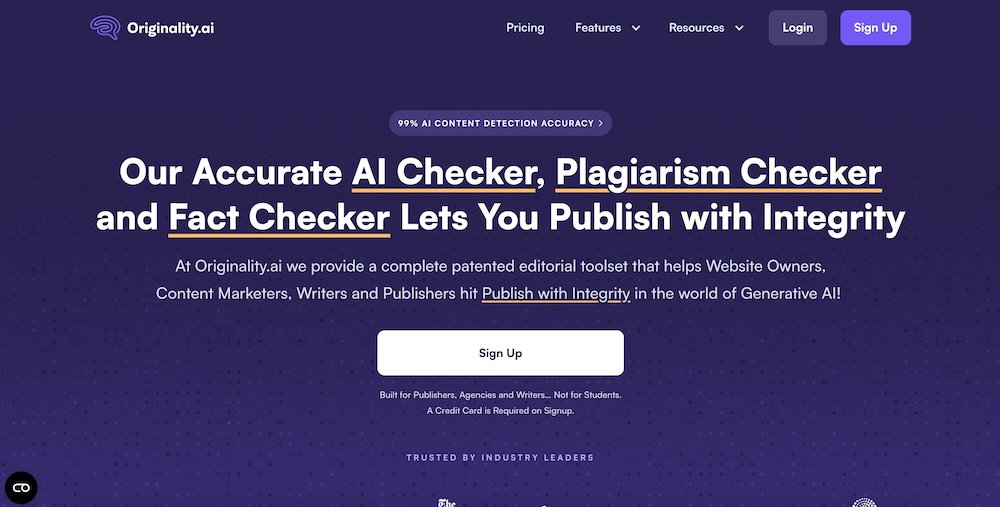
Originality.AI positions itself as the most accurate AI detector on the market, with a focus on web publishers, content marketers, and professional writers. The platform offers comprehensive content quality control beyond just AI detection.
Key Features
- 99% accuracy on GPT-4, Claude 3, and ChatGPT
- Full website scanning capabilities
- Fact-checking aid to verify content accuracy
- Plagiarism detection including paraphrase detection
- Team management and collaboration features
- Readability scoring based on Google ranking factors
- Three detection models (Lite, Turbo, Multi-Language)
Pricing
Credit-based system starting at $14.95/month for 2,000 credits.
Originality.AI is ideal for content publishers and agencies that need comprehensive content quality assurance beyond basic AI detection.
Choosing the Right AI Detector
Selecting the right AI detector depends on your specific needs, workflow, and budget. Here’s a detailed breakdown of what to consider:
Accuracy and False Positives
Accuracy is the most critical factor when choosing an AI detector. Look for tools that provide transparency about their accuracy rates and false positive percentages. False positives can be particularly problematic in educational or professional settings where human-written content might be incorrectly flagged as AI-generated.
Most top-tier detectors claim 99%+ accuracy, but independent testing results may vary. Tools like Originality.AI and Copyleaks have been validated by third-party studies, while others like GPTZero and Undetectable AI have received recognition from major publications.
Use Case Considerations
Educational Institutions
Schools and universities need detectors with strong LMS integration, batch processing capabilities, and detailed reporting. GPTZero and Copyleaks excel in this area with their Canvas, Moodle, and Google Classroom integrations.
Content Publishers
Publishers require comprehensive scanning capabilities, team management features, and additional quality control tools. Originality.AI stands out with its full-site scanning and fact-checking capabilities.
Individual Writers
Freelancers and individual content creators benefit from tools offering writing assistance alongside detection. Grammarly’s AI detector integrates seamlessly with their writing platform.
Agencies and Teams
Organizations managing multiple writers need team collaboration features, detailed reporting, and API access for workflow integration.
Technical Requirements
Volume Needs
Consider your monthly word count requirements. Some tools offer unlimited free scanning (like Scribbr), while others use credit-based systems. High-volume users may need enterprise solutions.
Integration Capabilities
API access is crucial for businesses wanting to integrate AI detection into existing workflows. Copyleaks and Originality.AI offer robust API solutions.
Security Requirements
Organizations handling sensitive content need tools with enterprise-grade security. Copyleaks offers military-grade security with SOC 2 and SOC 3 certification.
Language and Global Support
International users should prioritize tools with strong multilingual capabilities. Scribbr supports German, French, and Spanish, while Undetectable AI offers detection in 50+ languages.
The Future of AI Detection
As AI writing tools continue to evolve, detection technology must keep pace. The tools listed here represent the current state of the art, but the landscape is rapidly changing. Regular updates and improvements are essential as new AI models are released.
Most leading AI detectors now update their algorithms to detect newer AI models as they become available, ensuring continued effectiveness against the latest AI writing technologies.
The Bottom Line
Each of these seven AI detectors offers unique strengths for different user needs. Whether you prioritize accuracy, integration capabilities, multilingual support, or comprehensive content analysis, there’s a solution that fits your requirements. The key is matching the tool’s capabilities with your specific use case and budget constraints.
As AI technology continues to advance, having reliable detection tools becomes increasingly important for maintaining content integrity, academic honesty, and professional standards. These seven platforms represent the best options available for navigating the complex landscape of AI-generated content detection in 2025.
Frequently Asked Questions
How accurate are AI detectors?
Most leading AI detectors claim accuracy rates between 95-99%, but real-world performance can vary. Factors affecting accuracy include the AI model used to generate content, content length, and whether the text has been edited after AI generation. Independent studies have shown that tools like Originality.AI and Copyleaks consistently perform well in third-party testing, while some detectors struggle with shorter text samples or heavily edited AI content.
Can AI detectors identify content from newer AI models?
The best AI detectors regularly update their algorithms to detect newer models as they’re released. GPTZero, Copyleaks, and Undetectable AI explicitly mention detecting GPT-4, Claude, and Gemini content. However, there’s often a brief period when new AI models are released before detection tools catch up.
What are false positives and how common are they?
A false positive occurs when human-written text is incorrectly flagged as AI-generated. This can happen when human writing closely resembles AI patterns – often with formal, structured, or repetitive writing styles. Top detectors like Copyleaks report false positive rates as low as 0.2%, while others claim rates under 3%. False positives are particularly concerning in academic settings.
Do AI detectors work on paraphrased or edited AI content?
This is one of the biggest challenges for AI detectors. Many tools struggle with AI content that has been heavily edited, paraphrased, or run through “humanizing” tools. However, some detectors like Originality.AI specifically claim to detect paraphrased content, and Undetectable AI tests against multiple detection methods to show how content might perform across different tools.
Are free AI detectors as good as paid ones?
Free AI detectors often have limitations such as word count restrictions, fewer features, or less frequent algorithm updates. Tools like Scribbr offer unlimited free detection but with per-submission limits, while others like GPTZero provide limited free scans. Paid versions typically offer higher accuracy, more detailed analysis, batch processing, and additional features like plagiarism detection.
Can AI detectors tell the difference between different AI models?
Most AI detectors can identify that content is AI-generated but cannot definitively determine which specific AI model created it. They’re generally trained to recognize AI writing patterns rather than model-specific signatures. However, some tools like Undetectable AI show results across multiple detection platforms, which may provide insights into detection confidence levels.
How much text is needed for accurate AI detection?
Most AI detectors require a minimum amount of text for reliable results – typically 200-500 words for optimal accuracy. Very short text samples (under 100 words) are much harder to analyze accurately because there isn’t enough content to identify AI writing patterns. Longer texts generally provide more reliable detection results.
Will AI detectors become obsolete as AI improves?
This is an ongoing arms race between AI generation and detection technologies. As AI models become more sophisticated at mimicking human writing, detection tools must also evolve. The companies behind leading detectors continuously update their algorithms, but there will likely always be a period of adjustment when new AI models are released. Some experts believe detection may become increasingly difficult, while others argue that subtle patterns will always distinguish AI from human writing.